How to Start a Press Release Distribution Agency: Requirements, Profit Margins, and Automation
Building a profitable PR agency today requires zero direct publisher contracts. The secret lies in packaging wholesale infrastructure into a polished, high-margin client experience.

The barrier to entry for media distribution has never been lower, but the barrier to profitability remains high. You no longer need to negotiate publishing deals with hundreds of websites or build complex infrastructure to get your clients published. Instead, the modern agency model relies entirely on white-label infrastructure. You own the front door, the client relationship, and the strategy. Your wholesale partner owns the network. But a lower technical barrier means steeper competition. If you simply resell a network connection, your clients will eventually bypass you for a cheaper vendor. Success requires positioning your firm as a strategic partner that solves a business problem—be it search visibility, investor relations, or brand authority. This guide breaks down the mechanics of starting an agency in today’s landscape, detailing exactly where to spend your initial budget, how to structure your margins, and which operational bottlenecks to eliminate first.
In this article…
- 01Sell a Managed Outcome, Not a Publishing Network
- 02What a $500 Launch Budget Can Actually Buy
- 03Build the Front Door Before the Control Room
- 04Treat 20 to 60 Percent as a Pricing Target, Not a Promise
- 05Automate the Handoffs, Keep the Approval Gate
- 06Use Paid Orders to Decide Where to Invest Next
- 07Key takeaways
- 08Frequently asked questions
Sell a Managed Outcome, Not a Publishing Network
The fastest way to fail as a new agency is to compete on website volume. When you try to sell a list of sites, you reduce your business to a commodity. A potential client does not fundamentally want to buy a press release; they want the business result that comes with it. They are buying the credibility to put an 'As Seen On' banner on their homepage, the assurance that their company name populates search results for investors, or the immediate brand validation of appearing on major financial portals.
Focus your sales pitch on the managed outcome. You are selling a done-for-you service where the client provides a few bullet points, and your team handles the heavy lifting. They do not have to write the copy, navigate editorial guidelines, or worry about formatting. You take their rough news and turn it into a verified media placement. When you package the offering as an end-to-end campaign rather than a mere technical submission, you justify a premium price point and insulate your agency from competitors who just sell access to a wire service.
What a $500 Launch Budget Can Actually Buy
A common misconception is that you need thousands of dollars in capital to secure agency rates. In reality, a lean launch budget of around $500 is entirely sufficient to validate your business model and land your first paying clients. Your initial capital should strictly cover your front-facing assets and your first wholesale transaction.
Budget roughly $50 for a professional domain name and basic hosting. Allocate another $50 for a clean, conversion-focused checkout tool like Stripe or a premium form builder to collect client briefs. The remaining $400 is your buffer for fulfillment. When you secure your first order, you will use a reseller and white label programme to fulfill the distribution. Wholesale rates for premium networks typically run between $89 and $299 per campaign. By structuring your finances this way, your business is profitable from the very first client, and you never tie up cash in monthly software subscriptions or bulk credit packages before you have confirmed market demand.

Build the Front Door Before the Control Room
Many founders waste weeks configuring elaborate client portals and custom reporting dashboards before they have made a single sale. You do not need a login area for your clients. You need a frictionless checkout page and a reliable intake form.
Build the simplest possible front door. Your website should clearly state who you serve, what outcomes you deliver, and how much it costs. Use a standard intake form to collect the client's website link, quotes from their executives, and the core facts of their announcement. Once the invoice is paid, handle the project management internally. A shared spreadsheet or a basic task board is completely adequate for tracking drafts, approvals, and live links. If you are uncertain how to structure your service tiers, reviewing standard pricing structures from established distributors will give you a clear template for what the market expects to pay for regional, national, and premium financial distribution.
Treat 20 to 60 Percent as a Pricing Target, Not a Promise
Understanding your true profit margin is critical to long-term survival. If your wholesale cost for distribution is $200, and you charge the client $600, you have a gross margin of $400. However, this is not your net profit. You must account for the cost of fulfillment.
Writing a professional campaign requires a skilled writer, which can cost anywhere from $50 to $150 per draft depending on the complexity of the industry. You also need to factor in your own time spent communicating with the client, handling revisions, and managing the final unbranded reports. A healthy agency aims for a 50 to 60 percent gross margin on every package sold, giving you enough padding to absorb client acquisition costs and occasional refunds. Never price your services so low that a single round of heavy revisions pushes a project into a net loss. Protect your margins fiercely, and only discount for clients who commit to a recurring monthly retainer.
Automate the Handoffs, Keep the Approval Gate
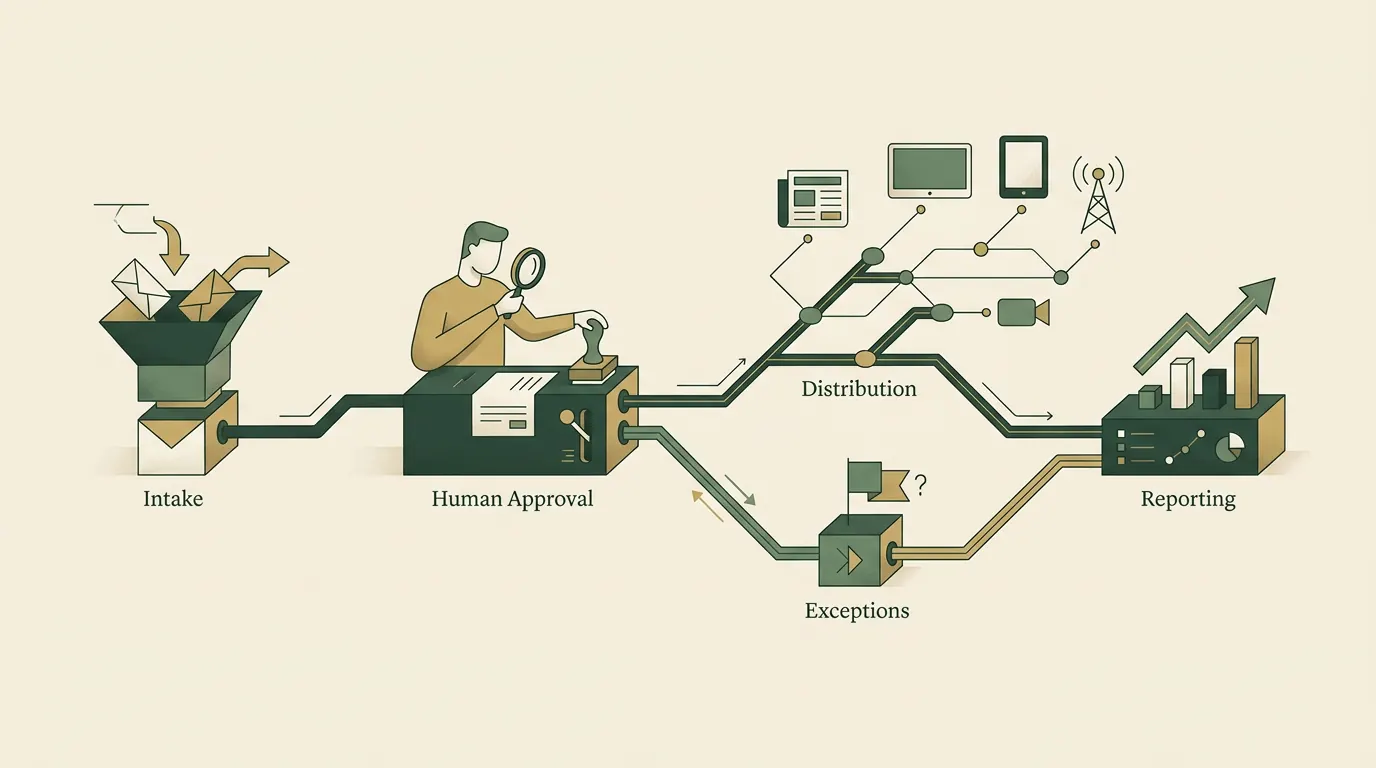
As order volume grows, automation becomes necessary to keep your overhead low. However, applying automation blindly will ruin your editorial standards. The goal is to automate the administrative handoffs while keeping human oversight on the actual deliverables.
Use workflow tools to connect your intake form directly to your project management software. When a client submits a brief, a system like Zapier should automatically create a task for your writer, generate an internal folder for assets, and notify you via email. This eliminates manual data entry. Conversely, never automate the editorial process. A human editor must review the final draft to ensure it meets standard formatting guidelines, verify that the dateline is accurate, and confirm that the text is actually newsworthy. If an article gets rejected by the wholesale network for policy violations, it delays the campaign and frustrates the client. Your approval gate is the final quality check that justifies your agency fee.
Use Paid Orders to Decide Where to Invest Next
Once your basic system is working, let your paying customers dictate your roadmap. Resist the urge to add complex services like dedicated brand tracking or custom outreach unless clients are actively asking for them and willing to pay an additional fee.
If your early clients consistently request wider visibility or specific niche publications, use that feedback to evaluate your wholesale partners. Reading reviews of the 5 Best Press Release Distribution Services In 2026 (And Why) can help you decide when it is time to upgrade your backend provider to support higher-tier publications. Reinvest your initial profits into targeted advertising or better copywriting for your landing pages rather than bloated software stacks. A lean, profitable agency that masters one core deliverable is always more resilient than a sprawling firm that tries to offer a dozen mediocre services on day one.
Key takeaways
Building a profitable press release distribution agency depends on packaging wholesale network access into a premium, managed service. Keep your startup costs strictly focused on customer acquisition, fiercely protect a 50 percent margin, and automate data handoffs without sacrificing your editorial standards.
See distribution plansFrequently asked questions
How much profit margin should a new PR distribution agency target?
A sustainable agency aims for a 50 to 60 percent gross margin on each campaign. If your wholesale fulfillment costs $200, your retail price should sit between $500 and $600 to cover writing fees, software expenses, and your time managing the client.
Can I launch a distribution agency without existing media relationships?
Yes. Modern agencies rely entirely on wholesale partners who have already negotiated the necessary network access. You manage the client strategy and the front-end sales, while your backend partner handles the technical delivery to the media.
What are the primary startup costs for this business model?
You can start with a lean budget of roughly $500. This covers a professional domain, secure website hosting, a reliable payment processor, and enough cash reserves to fund your very first wholesale order before you receive the final payout from your client.
Which parts of the agency workflow should I automate first?
Focus on automating data entry and client handoffs. Use standard workflow tools to push data from your initial intake form directly into your project management boards. This removes administrative bottlenecks while leaving your editorial review process manual and rigorous.
Why do clients pay an agency instead of going direct to a distributor?
Clients pay for a managed outcome. They do not want to write the copy, study formatting rules, or navigate complex submission portals. An agency removes that friction by offering a done-for-you service that guarantees a professional result without the learning curve.
Keep reading

4 min read
What Is AP Style for a Press Release and How to Do It (Example and Structure)
Learn exactly what AP style is, why journalists demand it, and how to format your press releases to avoid the trash bin. A pragmatic guide for standardizing datelines, numbers, and titles for maximum media pickup.
15 September 2026
6 min read
How to Use AI to Write a Press Release (+ Best Prompts)
Discover how to draft professional corporate announcements using the latest generative AI. This guide covers fact sheet preparation, tool selection, advanced prompting techniques, and strict editing rules to ensure your news is ready for journalists.
15 September 2026
5 min read
5 Best Press Release Distribution Services (and Why)
Discover the top news distribution platforms available today. This comprehensive guide reviews current pricing, network reach, and practical business advantages for each provider, helping you confidently select the best partner to secure measurable media coverage for your next corporate announcement.
15 September 2026Join the conversation
Comments are read by our editors before they appear on the page.